Crash Course on YouTube: Pure Gold

10 Mar

I have always liked the way Hobbits celebrate their birthdays. Instead of receiving gifts, they give a small gift to their friends and loved ones. In this way, nearly every single day of the year, a hobbit receives a small present. What a wonderful way to go through life.

Today is my birthday, so let me give you this small gift: subscribe to the Crash Course channel on YouTube. One of my star students (and the guy’s last name actually is Starr!) recently showed me John Green‘s analysis of The Great Gatsby, and I just had to pass it along:
(Also, there are a few more gifts in the other links I provided.)

Interactive Video (Part One): Flipping at TED-Ed

9 Mar

TEDedYou, like me, have spent a fair amount of time watching on-line videos. Who can blame us? When we need a break from grading, routines, or vacuuming, lovely owls, talking dogs, or five people playing one guitar are irresistible draws. Of course, video can be a powerful teaching tool, too. You surely are amazed by my obvious commentary. No? Well, let me try to impress you, then.

Two free online tools—Mozilla’s Popcorn Maker and TED-ed’s Flipped Interface–can make online videos more interactive. I am still in the early stages of experimentation with both, and my students are using the tools, so my opinions are still very much developing. Yet, at this nascent stage, I am intrigued (and harbor some reservations). In this post I will focus on the TED-ed channel’s “flip” interface.

You have probably already been to TED-ed. If not, stop reading this. Go there now. I’ll see you in a few hours.

TED-ed is a valuable resource for classroom teachers, a nicely edited platform with many visually arresting videos on a variety of topics. The “flipped” videos already have comprehension questions and supplemental resources built in.

Continue reading

My Dog Makes Me a Better Teacher

23 Feb

Finn's Crazy EyeI love mutts. I love all dogs, regardless of pedigree, but I have always favored the scrappy, intelligent mash-up that is a pound puppy. Every dog with which I have shared my life has been a rescue, and until my wife and I adopted Finn, an Australian Cattle Dog/Poodle mix so intelligent she could probably crack a safe, every dog I have welcomed into my life has been relatively easy work. Finn, however, is another story.

A cute but neurotic pup with a skull-rattling bark, Finn has required more training, patience, and “accommodations” in order to adjust to our lifestyle. And, more than any other dog for which I’ve cared, she has forced me to adjust my lifestyle to her. In just one year we were her third family, and I do not think many people would have the time or resources to help her in the way that we can. Of course, she helps me, too.

In both the classroom and my personal life, I expect things to work. I believe with enough thought and hard work, I can solve any problem. Yet, I have come to accept I will ever really “fix” Finn. I can help her become a calmer, more predictable, more relaxed dog, but I don’t know if she’ll ever be the “perfect” dog that I’ve had in the past. Accepting this fact is an ongoing process but one that teaches me quite a bit about myself.

I know she has made me a better teacher. As I change my mindset to better work with my dog, I realize I am bringing these positive attributes into my classroom as well.

 A good teacher (of dogs or humans) must…

Continue reading

Spanking Shakespeare: My Blind Date

16 Feb

pileofbookmarksWe do not have a library at my school. We do, however, have the BiblioTECH. The unusual name is purposeful, indicating our school’s focus on the intersection between books and information technology. Before you groan too loudly, don’t despair. Our BiblioTECH is still a place firmly dedicated to enticing young readers to fall in love with the printed word.

As part of a clever marketing campaign, our un-Librarian (yes…her official title) urged us to take a book on a blind date in February. She wrapped 30+ titles in brown paper and displayed them at the entrance. Anyone could pick a book at random, unwrap it at home, and agree to read it within two weeks. Of course, I couldn’t resist (nor could several of my students).

I’m pleased to report this blind date was a memorable one, an instant attraction filled with easy laughs and serendipitous connections. I was lucky enough to meet Jake Wizner’s Spanking Shakespeare.

spank_shakespeare_new_cvrShakespeare Shapiro, a witty and neurotic high school senior, longs to win his school’s memoir contest and lose his virginity. Naturally, in the course of his misadventures he learns a bit about his friends, his family, and himself. A very funny YA read that cleverly sidesteps a pat ending, this first-time novel was a delightful surprise.

I feel lucky to work with fellow passionate readers who are committed to enticing young people into the tribe. I hope you will consider setting up Blind Dates for the readers in your life. Some will be disasters, and others will just be “meh.” Yet, more often than we would expect, there’s magic in these chance encounters.

bookmark_origami

A “Typical” Day in a 1:1 Classroom (Part Two)

6 Feb
Beaver Country Day School

Robin working with his students

I love to know when my posts are “landing” or not, so please comment if you find this line of reflection helpful. When I sat down to record my thoughts on how teaching in a 1:1 classroom influenced one school day, I was not prepared for how many thoughts came out. This post is a continuation of  A “Typical Day” in a 1:1 Classroom: Part One, so read that first if you have not already done so:


Rhetoric 11

Membean Vocabulary Quiz / Discuss the class novel / Honors lessons / Revise literary analysis mini-essay

I see my classes five hours per week, with an optional sixth hour available for additional one-on-one help. This means three days a week I have a one hour block, one day a week I have a two-hour block, and one day per week I hold optional office hours during an “x-block.” This schedule has had the biggest positive impact on learning of any schedule I have ever encountered in my teaching career.

As in my sophomore classes, I began this class with a vocabulary quiz via Membean (explained in part one post):

Additional advantages of each student having a personal laptop:

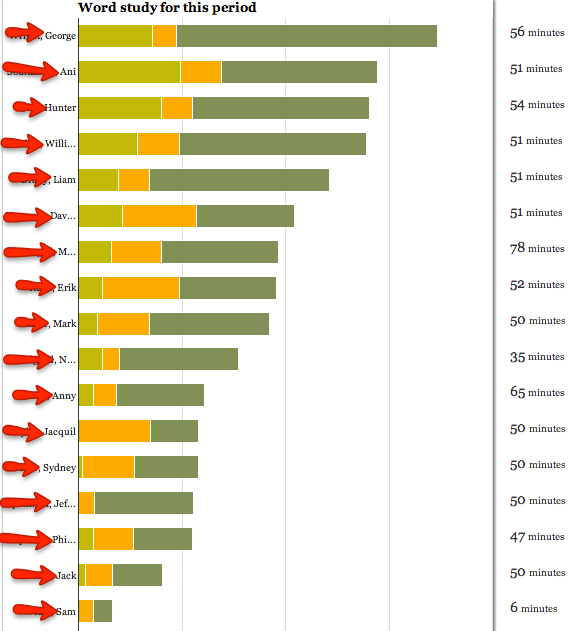
  • While students take the vocabulary quiz, I run a report of their Membean activity for the week [see below]. I require students to log at least 50 minutes per week and encourage them to complete short sessions (5-10 minutes) every day. Through the report I can tell who has completed the work in a timely manner. I can even tell if students have just left the program open for 50 minutes but not used it continuously during that time. (Unfortunately, I…like you…have some students who cut such corners.) After the quiz I quickly check in with each student, addressing issues of incomplete work.
Membean Post

A weekly Membean report

Continue reading

A Typical Day in a 1:1 Classroom (PART ONE)

2 Feb

Of course, a typical day in any classroom does not really exist. Our routines, systems, and practices serve our students, so when dealing with the individuals in our care, each day takes its own unique shape.

Yet, there is some use in examining a “typical” day in my English classrooms. For the past four years I’ve been lucky to work in a 1:1 school. I have found the advantages of having students “wired in” far outweigh the disadvantages.

For those who have not lived in a 1:1 laptop classroom, the very idea of it can seem Orwellian—students jacked-in to ear buds, mesmerized by a glowing blue screen instead of the far more interesting human beings around them. I have found, however, the reality of a 1:1 room is quite different. Every day I am convinced instant access to customizable technology can be a crucial component in making learning more efficient and dynamic.

Continue reading

Mini-essays: Go Small to Get Big Results

25 Jan

450450 words are usually enough to communicate effectively, even in a blog post.

Of course, bigger is not always better…or easier. Thinking back on my schooling, however, I always encountered a direct relationship between size and rigor. In order to make writing more challenging, my teachers made papers longer. The fifteen-page term paper is a mainstay of undergraduate and graduate years. While longer writing pieces have clear merit, they are not necessarily the most effective tools when helping apprentice writers.

Students can develop the critical writing skills they need by writing “smaller.” I have been using mini-essays to great success. The concept is simple.

Students respond to a prompt with a literary analysis essay that does not exceed 450 words. I still want original, critical analysis of the text, so students must get straight to the point.

My students still write longer essays, but I have found I can teach many of the same skills by limiting the word count. The students, too, often find the mini-essays more challenging than those without word limits.

Continue reading

Teaching Theme: The Red Tree

15 Dec
click the image to read more about this book

click the image to read more about this book

My very first department chair regularly read favorite books to his classes. He wasn’t a snob, either. He reveled in good writing, regardless of genre or target audience.

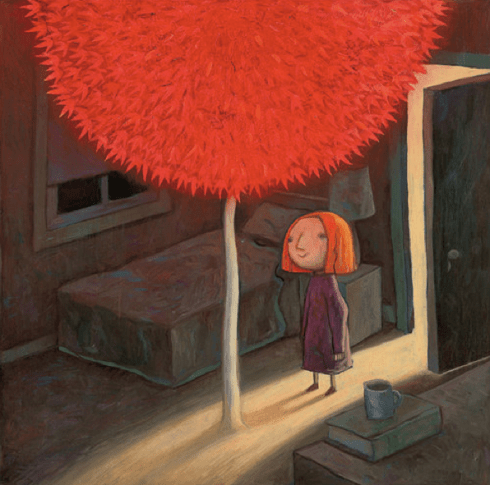
He was the first person to tell me about Harry Potter. He said something like, “The kids in England are reading this. It’s wonderful, and I think it’s going to be big over here.” Yes, he was a prescient guy. He was also brave. He often read picture books to seniors in high school…and they loved it. One of his favorite children’s books is now one of mine: The Red Tree by Shaun Tan. I use it to teach theme.

I begin my introductory lesson on theme by asking students to formulate a working definition (SEE THIS HANDOUT). As a class, they always come up with a decent one. I might have to do a bit of prodding, but this stuff is usually “in there.”

After collecting definitions, we refine our conception of theme. Depending on what was compiled in class (I usually use a common Google Doc to have students shape collective definitions), I emphasize certain aspects. My key points are always:

  • Multiple themes exist in any piece of art. Art is nuanced, so any painting, story, photograph, play, sculpture, or song will have multiple lessons within.
  • The author really means it. I tell my students, “I don’t think authors intend every message English teachers squeeze out of the work, but I’ve been around enough writers and written enough on my own to understand that writers are very intentional, even neurotic…so critical readers honor the craftsmanship of artists.” Or, I might just say, “They mean most of this stuff. Trust me.”
  • A theme is never one word. There’s a difference between topics and themes. Family, love, and betrayal are all topics. The specific comment the author wants to make about families is the theme.

No surprise. The students breeze through the definition process but STRUGGLE to write coherent, original theme statements that go beyond the obvious and avoid simple summary. In other words, they can define concepts but need help applying them. No matter… I keep my job because they need such help.

Continue reading

T.V. as Text: Secret Millionaire Essay

8 Dec

Livro ou TV?I will not shock fellow English teachers when I write that most of my students watch television more often than they read. I’m not complaining. I actually think the current generation of teenagers reads more often than the previous one…thank you, Ms. Rowling.

I have, however, been thinking about how I can use my students’ love of T.V. to make them more critical, artistic writers. If I can help them become more empathetic human beings in the process, then maybe I will finally get into Gryffindor.

In recent years I have asked my students to write about ABC’s show Secret Millionaire. For those of you unfamiliar with the show, a millionaire goes undercover for the week, posing as a regular person who happens to be making a documentary about volunteerism. The millionaire visits an impoverished neighborhood and volunteers at charitable organizations within the community. At the end of the week, the millionaire returns to the organizations, reveals his or her identity, and leaves a fat check.

As a way to help students develop skills of persuasion, organization, and communication, I assign this essay. They write to their fellow students, and I ask the most successful writers to submit their pieces to our school newspaper and other online sources like teenink.com.

Continue reading

My Mustache Was Made in China

28 Nov

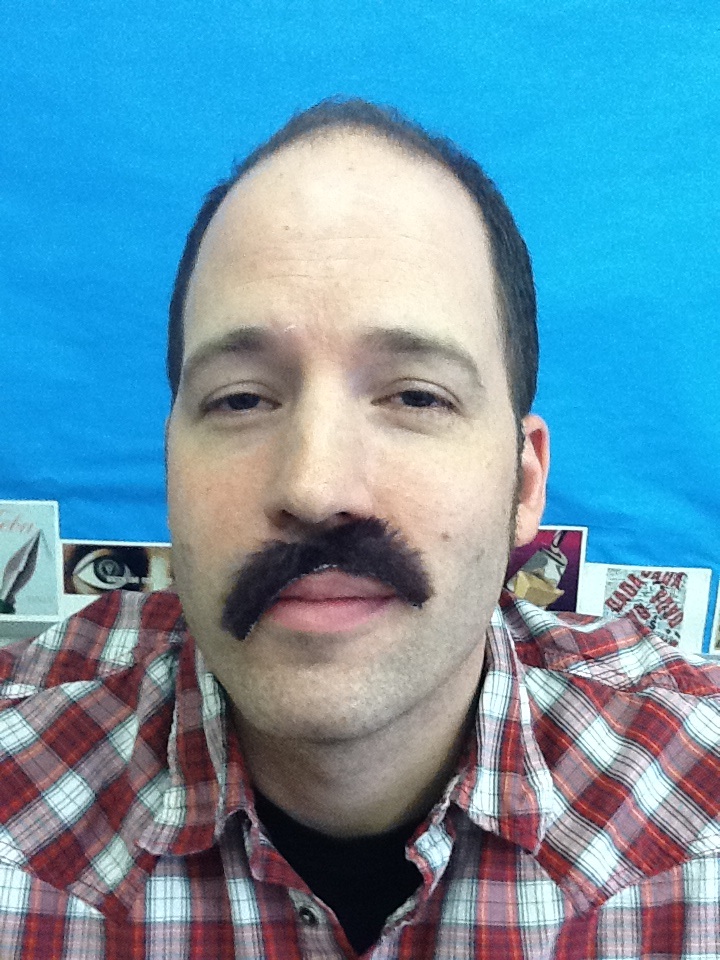
This most excellent fake mustache was made were most everything seems to be made…China. I, like you, buy things without ever really thinking about their origins. In this case, I just thought it might be useful to have a stash of fake ‘staches in the classroom. Of course, they’ve proven to be invaluable in so many ways.

In this case, the mustache was just another item I used to illustrate our global supply chain. Allow me to explain.

A “Made in China” Scavenger Hunt has been one of the most successful “go to” lessons I’ve created in recent years. The idea is fairly simple:

  1. Divide the class into teams of 2-4.
  2. Give the teams five minutes to search anywhere in the room for a “Made in China” label.
  3. Bribe them with a wonderful and mysterious prize for the team who finds the most items. (I keep a “Bag ‘O Mystery” on hand filled with odd flea market and garage sale finds. I gave away a Chewbacca bobble-head the other day that was particularly coveted.)
  4. Step back and watch them go.

Continue reading

MAKE THEM MASTER IT

CONNECTING TEACHERS TO INTENSIFY OUR IMPACT

carlabramowitz

Explore with Curiosity. Create with Love

TeacherToolkit

Most Influential UK Education Blog

Robin Neal

a teacher energized by innovation and collaboration

Popsicles for Dinner

The adventures of Liza and Felix

couponbomb

A year long quest of doing stuff...

Lehrer Werkstatt

Reflections on Living and Teaching in Germany

Student Observation

every day observations from a student's perspective

Empathic Teacher

The Mindful High School Classroom

Expat Educator

Leadership and Educational Practice from Around the World

Ideas Out There

THINK. LEARN. DO. REPEAT...

So, will this be graded?

Stories from a middle school English teacher turned high school English teacher.

History Tech

History, technology, and probably some other stuff

I'm Teaching English

And trying to get better each day. Thanks for your comments!

thefreshmanexperience

Life's lessons learned from students at school...

TED Blog

The TED Blog shares news about TED Talks and TED Conferences.

WordPress.com News

The latest news on WordPress.com and the WordPress community.

Classroom as Microcosm

Siobhan Curious Says: Teachers are People Too