Tag Archives: pedagogy

I Hate You, IKEA: What Moving Teaches Me

3 Aug
uploaded to Flickr by yamzombie

uploaded to Flickr by yamzombie

Only after deep reflection and with considerable guilt can I write the following confession: I hate you, IKEA. Yes, you offer accessible design at incredible prices, and without you I would never be able to decorate my apartment or organize my classroom drawers. I will even confess to an unhealthy devotion to your meatballs and Prieselbeeren sauce.

But, for purely selfish reasons, I am done with you (for a week at least). I cannot stomach another turn of your fjborking screws or another frustrated thumbing-through of the pictographs you call directions. In other words, I have grown tired of the minutia connected with moving.

I am not complaining. REALLY, I am not. The upheaval associated with an Intercontinental move is a small price to pay for the wonderful opportunity my wife and I have received. In July we moved back to a small town outside Frankfurt, Germany, where we lived and taught prior to our time in Boston. It has been a homecoming in many ways. We return to incredible friends, a lovely little apartment, a lifestyle that brings a sense of adventure to even the most mundane tasks, and, yes, the beer is not bad either. We are more than a little happy.

The First BeerI begin work at my new (old) school next week, and as I put away my physical toolbox and dust off my metaphorical one, I have been thinking about how this move will influence my life as a teacher:

Remember, be patient. I like to think of myself as a pretty chilled out man, but the ongoing “to do” list connected to a big move reminds me that I make significantly more progress when I slow down and relax. Despite my best efforts, I still struggle mightily to speak German. I have great support systems here, but I try to do as much as I can on my own. In order to connect my satellite dish, figure out which section of grass is o.k. for my dog to use, buy a new car, make chit-chat with a neighbor, or do just about anything else I need to do after stepping out the front door, I have to patiently communicate using my caveman German and highly refined Charades skills. Not actually being an idiot but sounding like one for the majority of my day is incredibly frustrating, but I know I will be more empathetic to my students’ struggles throughout the school year as a result. Patience is, indeed, a virtue, in life and in the classroom.


Continue reading

Year 16 Recap: Every Single Day

8 Jun

I have jumped out of an airplane only once in my life, and what I remember most vividly is the sound. Upon first jumping from the plane the ripping wind and my own primal screams mixed into a roaring mayhem that I can’t really recall, but once the chute deployed, a clean silence instantly replaced the chaos.

The end of every school year feels similar. The wild stir of things-to-do is quickly replaced with sudden (and delicious) emptiness. I always try to savor this shift and give myself at least one day of nothingness.

My last day with students was yesterday. As I end my 16th year in the classroom, I can’t honestly write that I have reached this beautiful absence of work. I am moving to Germany at the end of this month, so I still have a crazy amount of things to do.

Therefore, since I am not yet free of the howling wind of the school year, I’ll make this post brief . . . but hopefully useful. I keep my class calendars through Google Docs and Google Sites and thought it might be interesting to share with you what my students and I did this school year. Here you go. Each day of my school year is here. Dip in. Ignore it completely. Stalk us through every single day. I hope you find something useful.

Public Speaking: TEDx Classroom

American Literature 10th Grade

Rhetoric 11th Grade

An Alternative to Traditional Summer Reading

5 Jun

Our Head of School hates summer reading. He has banned it.

Before you think ill of him, he’s a former English teacher who cares deeply about engendering a love of reading in all students. His position? Assigned summer reading does more harm than good.

Our students, then, are required to read the equivalent to at least three novels over the summer. They decide what they read. They can even read magazines, blogs, or other genres as long as this reading approximates the length of three books.

We want our students to read habitually, and we want them use summer reading time to explore their passions. When they return from summer break, we spend some time talking about their summer reading (and I have them write about it). We do not, however, quiz them or assign major projects. The program is largely run on an honor system.

Now, I KNOW some students fail to complete any summer reading. Yet, far fewer students slack off than one would think. The majority of the students choose appropriate, engaging work, and as a result, many more students enjoy summer reading.

It’s important to note, too, that the majority of the students I teach do NOT consider themselves natural readers or writers. Many of my students have language-based learning issues that require some form of accommodation. A choice-based system, especially for this population of reluctant readers, makes even more sense.

Over the three years we have used this summer reading policy, I consistently receive feedback from struggling readers about how it has helped them. I have also found that all students are more likely to continue to have a positive attitude toward our choice reading throughout the school year because they have been given the chance to develop their own reading habits.

Betty writes: “At the end of every school year, there’s only one thing I actually dread that’s upcoming in the summer, and that’s summer reading. Some of the books that I’ve had to read in middle school were absolutely dire, probably the most uninteresting stories I’ve ever had to sit through. The fact that I’m not an avid reader and that I don’t enjoy it in general makes it all the worse. The Beaver summer reading policy helped me as a reader in many ways, mostly by letting me be engaged in the texts that I got to choose on my own.”

Jackson writes, “In most cases when I read an assigned book over the summer, I only read it because I have to. I tend not to be very engaged and just read to finish the book. In addition, I usually take the lazy way out while reading an assigned book. I might end up skipping parts of the book, which does not happen if I am reading a book that interests me. When I read a good book, tt usually makes me want to read more books and expand my knowledge. I think this goes for a lot of kids out there that are in the same boat as me.”

Carl writes, “I have never liked to read very much, but the summer reading policy allowed me to be interested and actually like what I was reading. Beyond that, it also made me want to read…I read the book American Fencer, and I was very interested in this book because he was going through a process of international and Olympic fencing, which I would like to do someday.  I think that I am the only one in the class that would be interested in the book, so it would not get assigned by any teacher.  Because I was able to read a book that I was interested in, there were times during the summer that I wanted to pick up a book and read instead of doing something like play video games.  If we were assigned books I would have tried to procrastinate and avoid reading as much as possible.”

These three students (changed their names, of course) grew so much this year, and they are representative of the type of student I love to teach…an interesting, independent student who just doesn’t really “get” English class without some help. While each of them is still not likely to consider himself or herself a “reader,” each approaches reading with far less dread than one year ago. I know that my work in the classroom has helped shaped their improved attitude toward reading, and I’m happy that our summer reading policy nurtures this enthusiasm instead of squashing it.

It really is impossible to choose the perfect summer reading book to assign every student, so I think we should stop trying. Instead, set a total book (or page) goal, and let the students choose their own texts. We can tackle the dense stuff during the school year. Such an approach will do more to engender a love of reading that lasts well beyond our time with each individual student.

Alternative Classroom Discussion Formats

25 May

I’m closing in on my sixteenth year in an English classroom, and as any veteran teacher will admit, falling into ruts can be fairly easy. I will freely acknowledge that I can sometimes slip into default mode, especially when it comes to class discussions. I know how to foster a well-paced, inclusive discussion that avoids the Select Few dominating the discourse. I don’t, then, feel particularly impelled to change the format. But, boy, I’m glad that I still do.

My colleague in sophomore English is a gregarious, inventive, and reflective teacher just finishing his second year. He has some really good ideas on how to flip modes of discussion to play to various students’ strengths. In this post, I’m just going to rip off his ideas (and some ideas from others), giving full credit, of course.

The Experts Panel:

My colleague came up with this idea. At my school, students taking English for honors credit and those receiving standard credit are in the same section. We have to differentiate in some creative ways. One thing honors students must do is read an extra book and participate in extra discussions outside of class. This term students read Swamplandia! by Karen Russell.

As the students read the book, we constructed a series of Fishbowl Discussions to monitor their understanding of the text. (More on the Fishbowl technique below.) For the final discussion, however, we devised an alternative format using Google Hangouts. Unfortunately, we hit a snag. Users under 18 years of age cannot record Google Hangouts. Scrambling for an alternative, my colleague came up with the Experts Panel format.

We determined general categories of discussion topics beforehand and asked each student to prepare a few discussion questions from each category, emphasizing that the quality of their questions would help us gauge their understanding of the novel.

On the day of the discussion, we randomly chose three to four students to sit at the front as our expert panel. Then, using wheeldecide.com to make a spinner, we randomly chose the topic. In addition to the categories listed in the assignment description, we added Teacher’s Choice and random prizes.

Once the category was chosen, the audience asked questions and the panelists provided answers. When a topic was exhausted, we rotated panelists, with every student getting a chance to be an expert. Of course, the teachers asked questions and sat on a panel, but we were largely observers.

The rapid fire Q&A format led to one of the best literary discussions of my teaching career. Students on the experts panel really worked to provide erudite and original answers, while a healthy competition arose in the audience to ask the most intelligent question.

This Experts Panel format would work for any subject area. Of course, if used too often any format becomes tedious, but the students truly responded to this approach.

Fishbowl Discussion:


This video at Edutopia does a better job than I could explaining the format. As my honors students read Swamplandia! we scheduled a few fishbowl discussions so I could monitor their understanding and guide their analysis. Students also took notes on a shared Google Doc as they discussed so they could reference these notes later on. Due to numbers, I was the only one on the outside of the fishbowl, but I’ve used this format often. Giving students the chance to observe discussion can greatly improve their contributions when they are active participants.

Structured Academic Conversation as Debate Alternative


Tweet the Debate


Alternative Discussion Formats: Dr. Cavanaugh


50 Alternatives to Lecture

Writing Rubric Reboot: 6plus1

30 Apr

red penIn my second year of teaching, I made a grievous, but memorable, error. I was always the type of student who was motivated by tough love. My favorite teachers were the ones with the highest expectations, and a scribbled, gruff marginal note like, “You’re a better writer than this. Try again” was often enough to send me under the hood of the text. Of course, I am not every student. Wanting to motivate a student I knew could do much better, I returned her essay with this brief message scrawled across the top, “This is the worst essay I have ever read. Try again.”

Looking back, I don’t recognize the young teacher who would be so callous with a not-much-younger student. Of course, my comment only did harm. It gave my student no hope, no information about what to do next. The only saving grace about this regrettable action? I was allowing her to revise. That, and I learned to never do something like this again.

Thankfully, this student and I worked past this incident. I apologized; she forgave. A year later, she moved to another school, but during a return visit, she visited me and shared the 6plus1 Writing Traits rubric her new English teacher was using. Not surprisingly, it was helping her, and I instantly adopted the practice in my own classes.

Over the years, for whatever reason, I have drifted away from the 6plus1 terminology, but this trimester I decided to bring it back. The shift only required slight alterations to the scoring guides I already used:

Timed Essay Scoring Guide w/ 6+1

The Six Plus One traits have existed since the mid-80s, and these descriptors of good writing are an attempt to quantify what makes writing work. Using them—especially when they are used across grade levels and disciplines—can demystify writing feedback for students and help them recognize what they do well and target what they need to improve.

Continue reading

Wikis as Textbooks

7 Apr
Is it just me? Every time I hear WIKIS I think about wookies.

Is it just me? Every time I hear WIKIS I think about wookies.

Let’s be honest. Wikis are ugly. At least the wikis I make are not sleek and arresting in a visual sense. Yet, I use wikis in a variety of ways that I find elegant and interesting. Think of them as a ten-year-old Toyota Corolla. They usually won’t turn heads, but they run beautifully and always do what they should.

Wikis as Textbooks

This past fall, I taught a brand spankin’ new public speaking course based on TED talks. I had never taught public speaking, so in preparation, I searched for the perfect textbook. I have never used a textbook in any class, but my own insecurities where sending me looking for some solid backup. Well, I didn’t find the perfect textbook (because they don’t exist). Instead, I decided to have the students create their own textbook using a class wiki:

Public Speaking Class Textbook

The experience reinforced my belief in constructivism. While far from perfect, our self-constructed textbook served our purposes perfectly. After giving their first speeches, I asked the students, “O.K. Now that you’ve given one speech, what do you think you need to learn?” Their answers became our chapters.

Continue reading

Interactive Video (Part One): Flipping at TED-Ed

9 Mar

TEDedYou, like me, have spent a fair amount of time watching on-line videos. Who can blame us? When we need a break from grading, routines, or vacuuming, lovely owls, talking dogs, or five people playing one guitar are irresistible draws. Of course, video can be a powerful teaching tool, too. You surely are amazed by my obvious commentary. No? Well, let me try to impress you, then.

Two free online tools—Mozilla’s Popcorn Maker and TED-ed’s Flipped Interface–can make online videos more interactive. I am still in the early stages of experimentation with both, and my students are using the tools, so my opinions are still very much developing. Yet, at this nascent stage, I am intrigued (and harbor some reservations). In this post I will focus on the TED-ed channel’s “flip” interface.

You have probably already been to TED-ed. If not, stop reading this. Go there now. I’ll see you in a few hours.

TED-ed is a valuable resource for classroom teachers, a nicely edited platform with many visually arresting videos on a variety of topics. The “flipped” videos already have comprehension questions and supplemental resources built in.

Continue reading

A “Typical” Day in a 1:1 Classroom (Part Two)

6 Feb
Beaver Country Day School

Robin working with his students

I love to know when my posts are “landing” or not, so please comment if you find this line of reflection helpful. When I sat down to record my thoughts on how teaching in a 1:1 classroom influenced one school day, I was not prepared for how many thoughts came out. This post is a continuation of  A “Typical Day” in a 1:1 Classroom: Part One, so read that first if you have not already done so:


Rhetoric 11

Membean Vocabulary Quiz / Discuss the class novel / Honors lessons / Revise literary analysis mini-essay

I see my classes five hours per week, with an optional sixth hour available for additional one-on-one help. This means three days a week I have a one hour block, one day a week I have a two-hour block, and one day per week I hold optional office hours during an “x-block.” This schedule has had the biggest positive impact on learning of any schedule I have ever encountered in my teaching career.

As in my sophomore classes, I began this class with a vocabulary quiz via Membean (explained in part one post):

Additional advantages of each student having a personal laptop:

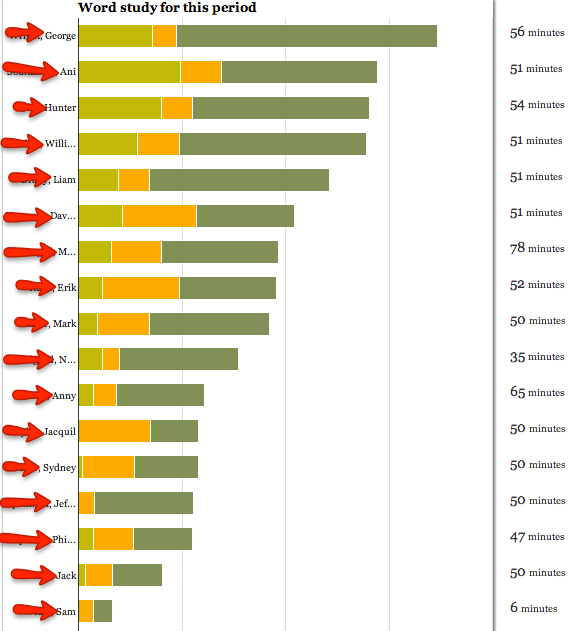
  • While students take the vocabulary quiz, I run a report of their Membean activity for the week [see below]. I require students to log at least 50 minutes per week and encourage them to complete short sessions (5-10 minutes) every day. Through the report I can tell who has completed the work in a timely manner. I can even tell if students have just left the program open for 50 minutes but not used it continuously during that time. (Unfortunately, I…like you…have some students who cut such corners.) After the quiz I quickly check in with each student, addressing issues of incomplete work.
Membean Post

A weekly Membean report

Continue reading

A Typical Day in a 1:1 Classroom (PART ONE)

2 Feb

Of course, a typical day in any classroom does not really exist. Our routines, systems, and practices serve our students, so when dealing with the individuals in our care, each day takes its own unique shape.

Yet, there is some use in examining a “typical” day in my English classrooms. For the past four years I’ve been lucky to work in a 1:1 school. I have found the advantages of having students “wired in” far outweigh the disadvantages.

For those who have not lived in a 1:1 laptop classroom, the very idea of it can seem Orwellian—students jacked-in to ear buds, mesmerized by a glowing blue screen instead of the far more interesting human beings around them. I have found, however, the reality of a 1:1 room is quite different. Every day I am convinced instant access to customizable technology can be a crucial component in making learning more efficient and dynamic.

Continue reading

Mini-essays: Go Small to Get Big Results

25 Jan

450450 words are usually enough to communicate effectively, even in a blog post.

Of course, bigger is not always better…or easier. Thinking back on my schooling, however, I always encountered a direct relationship between size and rigor. In order to make writing more challenging, my teachers made papers longer. The fifteen-page term paper is a mainstay of undergraduate and graduate years. While longer writing pieces have clear merit, they are not necessarily the most effective tools when helping apprentice writers.

Students can develop the critical writing skills they need by writing “smaller.” I have been using mini-essays to great success. The concept is simple.

Students respond to a prompt with a literary analysis essay that does not exceed 450 words. I still want original, critical analysis of the text, so students must get straight to the point.

My students still write longer essays, but I have found I can teach many of the same skills by limiting the word count. The students, too, often find the mini-essays more challenging than those without word limits.

Continue reading

MAKE THEM MASTER IT

CONNECTING TEACHERS TO INTENSIFY OUR IMPACT

carlabramowitz

Explore with Curiosity. Create with Love

TeacherToolkit

Most Influential UK Education Blog

Robin Neal

a teacher energized by innovation and collaboration

Popsicles for Dinner

The adventures of Liza and Felix

couponbomb

A year long quest of doing stuff...

Lehrer Werkstatt

Reflections on Living and Teaching in Germany

Student Observation

every day observations from a student's perspective

Empathic Teacher

The Mindful High School Classroom

Expat Educator

Leadership and Educational Practice from Around the World

Ideas Out There

THINK. LEARN. DO. REPEAT...

So, will this be graded?

Stories from a middle school English teacher turned high school English teacher.

History Tech

History, technology, and probably some other stuff

I'm Teaching English

And trying to get better each day. Thanks for your comments!

thefreshmanexperience

Life's lessons learned from students at school...

TED Blog

The TED Blog shares news about TED Talks and TED Conferences.

WordPress.com News

The latest news on WordPress.com and the WordPress community.

Classroom as Microcosm

Siobhan Curious Says: Teachers are People Too