Tag Archives: pedagogy

Teaching Theme: The Red Tree

15 Dec
click the image to read more about this book

click the image to read more about this book

My very first department chair regularly read favorite books to his classes. He wasn’t a snob, either. He reveled in good writing, regardless of genre or target audience.

He was the first person to tell me about Harry Potter. He said something like, “The kids in England are reading this. It’s wonderful, and I think it’s going to be big over here.” Yes, he was a prescient guy. He was also brave. He often read picture books to seniors in high school…and they loved it. One of his favorite children’s books is now one of mine: The Red Tree by Shaun Tan. I use it to teach theme.

I begin my introductory lesson on theme by asking students to formulate a working definition (SEE THIS HANDOUT). As a class, they always come up with a decent one. I might have to do a bit of prodding, but this stuff is usually “in there.”

After collecting definitions, we refine our conception of theme. Depending on what was compiled in class (I usually use a common Google Doc to have students shape collective definitions), I emphasize certain aspects. My key points are always:

  • Multiple themes exist in any piece of art. Art is nuanced, so any painting, story, photograph, play, sculpture, or song will have multiple lessons within.
  • The author really means it. I tell my students, “I don’t think authors intend every message English teachers squeeze out of the work, but I’ve been around enough writers and written enough on my own to understand that writers are very intentional, even neurotic…so critical readers honor the craftsmanship of artists.” Or, I might just say, “They mean most of this stuff. Trust me.”
  • A theme is never one word. There’s a difference between topics and themes. Family, love, and betrayal are all topics. The specific comment the author wants to make about families is the theme.

No surprise. The students breeze through the definition process but STRUGGLE to write coherent, original theme statements that go beyond the obvious and avoid simple summary. In other words, they can define concepts but need help applying them. No matter… I keep my job because they need such help.


Continue reading

T.V. as Text: Secret Millionaire Essay

8 Dec

Livro ou TV?I will not shock fellow English teachers when I write that most of my students watch television more often than they read. I’m not complaining. I actually think the current generation of teenagers reads more often than the previous one…thank you, Ms. Rowling.

I have, however, been thinking about how I can use my students’ love of T.V. to make them more critical, artistic writers. If I can help them become more empathetic human beings in the process, then maybe I will finally get into Gryffindor.

In recent years I have asked my students to write about ABC’s show Secret Millionaire. For those of you unfamiliar with the show, a millionaire goes undercover for the week, posing as a regular person who happens to be making a documentary about volunteerism. The millionaire visits an impoverished neighborhood and volunteers at charitable organizations within the community. At the end of the week, the millionaire returns to the organizations, reveals his or her identity, and leaves a fat check.

As a way to help students develop skills of persuasion, organization, and communication, I assign this essay. They write to their fellow students, and I ask the most successful writers to submit their pieces to our school newspaper and other online sources like teenink.com.

Continue reading

My Mustache Was Made in China

28 Nov

This most excellent fake mustache was made were most everything seems to be made…China. I, like you, buy things without ever really thinking about their origins. In this case, I just thought it might be useful to have a stash of fake ‘staches in the classroom. Of course, they’ve proven to be invaluable in so many ways.

In this case, the mustache was just another item I used to illustrate our global supply chain. Allow me to explain.

A “Made in China” Scavenger Hunt has been one of the most successful “go to” lessons I’ve created in recent years. The idea is fairly simple:

  1. Divide the class into teams of 2-4.
  2. Give the teams five minutes to search anywhere in the room for a “Made in China” label.
  3. Bribe them with a wonderful and mysterious prize for the team who finds the most items. (I keep a “Bag ‘O Mystery” on hand filled with odd flea market and garage sale finds. I gave away a Chewbacca bobble-head the other day that was particularly coveted.)
  4. Step back and watch them go.

Continue reading

Do Your Students’ Work

10 Nov

When teaching AP or IB English, one of the most useful things I did each year was to write at least one of the essays I assigned my students. I would select a textual response prompt I had never seen before and, within the same time constraints set on the students, I would read, analyze, and respond. I would then slip my anonymous response in with the model essays we used during review. It was always humorous and enlightening to hear my students praise and criticize my work, and once I revealed my response, they were always appreciative that I had put myself “out there.”

As teachers we can easily fall into the trap of forgetting the messy, recursive and challenging process of learning. As we repeat lessons throughout the day or re-read books each year, we remove ourselves further from the inevitable struggles inherent in any learning process. To heighten my empathy for my students’ challenges and to model good learning in action, I often do my students’ work. I try, at least once a term, to complete one of my own assignments.

I gave an Ignite speech right along with my students. An Ignite speech is five minutes long, and the speaker creates 20 slides that auto-advance every 15 seconds. I have never given such a speech, so I knew I needed to do it as well. I’m glad I did. Had I simply assigned it, I never would have understood how difficult this format really is.

I easily invested six hours into my five minute speech, and I even had to take a “mulligan” when delivering the speech to the class. In the end, however, I am happy with the results.

Continue reading

Paper Airplanes for Freedom: Who Cares?

3 Nov

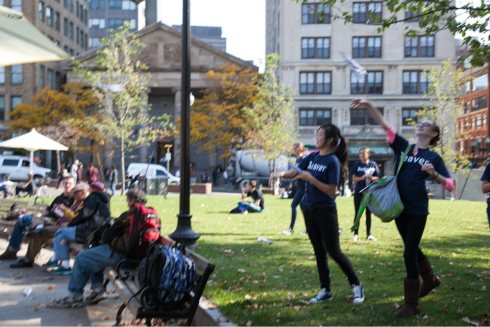
Most teachers would probably naturally intuit this, but carting 20 students to downtown Boston so they may throw paper airplanes at strangers is probably not a good idea. Too many things could go wrong, and why, exactly, would they want to do this in the first place?

I was cautious, but I really care about putting students’ ideas at the forefront of learning, so we executed this harebrain idea anyway. It did not go so well. And, it was a huge success.

How can it be both? First some background….We used CNN’s Freedom Project throughout the term as one source for our research on modern slavery. One posted assignment, Paper Airplanes for Freedom, intrigued us. It is pretty simple: make a paper plane, write messages of solidarity on it, launch it, and encourage those that pick it up to do the same. It’s a novel way of spreading awareness. More slaves exist in the world today than at any point in human history….27 million by some counts. 

As we brainstormed our own ideas for raising awareness, the students had an overwhelming urge to create a public action. During the idea generating and iteration phases, “Paper Airplane Flash Mob” rose to the top. The students and I thought it represented a chance to grab people’s attention and make a lasting impression.  We also thought we could execute it relatively easily.

Continue reading

Low Prep #Reading Quizzes that Are Quick to Grade

20 Oct

As an English teacher I must sometimes act as a gatekeeper. I care deeply about engendering a love of reading in my students, and I work diligently toward that end…but I also create situations where I just try to determine a very basic answer to a very basic question, “Did you read it or not?”

This step seems obvious, but many teachers leave this fundamental question to chance. They believe their students will read because they were told to read, but I argue that this kind of trust is actually a disservice to the learners in our classrooms. I am a very optimistic man who believes in second chances and basic human decency, but as an English teacher I am also a crusty, pragmatic troll guarding a bridge. If you didn’t read the book, you’re not getting by me. Let me explain…

I always give a reading quiz the day before I want to discuss the book. This simple step allows me time to determine who has read, and it gives unprepared students a bit of time to catch up. With these quizzes I check for basic reading completion one of three ways:

Continue reading

Occam’s Razor, Summer Reading Essays, and Google Docs

1 Oct

I am ashamed. Why do simple solutions often elude me? I have been using Google Docs for five or six years now, and one of the main beefs I have with the system is the highlighting tool. It seems like such a small thing, but there is not a way to leave the highlighting tool “on.” I want—desperately—to sweep my cursor across the page, highlighting text as if I had a physical highlighter in hand. Word allows this. Google Docs, however, requires several clicks and menu choices to highlight something, and the process slows things down considerably, especially for an English teacher who reads hundreds of essays in a year and is always on the hunt for ways to shave seconds off the feedback process.

Just last week I realized I have been ignoring a simple solution. I can simply use the comments keyboard shortcut [Option+COMMAND+M] to save considerable time. Now, I highlight my selection, hit a few keys, and then type a quick note: “error #.” It’s so much simpler…and I am a bit sickened by the time I have wasted.

http://www.youtube.com/watch?v=uZ4Me_QtGd8

Continue reading

Little Things Add Up and Other Life Lessons

18 Sep

I begin each week in the classroom with a Life Lesson. These lessons typically last five minutes, but my goal is to share with students some truth I hold dear. This week’s lesson: Little Things Add Up.

A few years ago Steve Bergen, while teaching at the Children’s Storefront School in Harlem, NY, started a Billion Penny Project. The idea began as a math lesson and quickly blossomed into a novel fundraising campaign. CBS picked up the story and ran this piece. I was part of the campaign and even made a brief appearance on national TV. Blink and you will miss me; I am in the red sweater:

Continue reading

Building Effective Classroom Discussions #1st5days

12 Sep

I will admit it. I steal many of the great ideas I use in the classroom. If you want to be a better teacher, you probably find inspiration from others, too.

Steal, of course, is a harsh word. I always give credit. But,  while I know I am a creative teacher in my own right, I have no problem using someone else’s great idea.

Early in my teaching career I attended a Building Success workshop sponsored by the College Board, and the facilitator gave this suggestion. (I would give his name if I knew it; I have tried to find it). Early in the school year, he posts the following list somewhere in the classroom:

  •      – The correct answer
  •      – An educated guess
  •      – A wild guess
  •      – A blank stare

He then begins class by asking students to consider the list and answer the following question: “Which response do you learn the most by giving?” I have stolen his idea every year.

Continue reading

#Flipclass with Membean: A Vocabulary System that Works

18 Jul

I would tell you how I incorporate vocabulary in my English classes, but I’m betting you already know. Chances are we pretty much do the same thing. This spring I did something different. Flipping a classroom is not really about turning lectures into videos, it’s about freeing up class time for more one-on-one interaction with students. Here’s one way I’ve done this.

Replacing a whole class vocabulary list with Membean.com was the most successful experiment of the school year. My students learned at least twice as many words, and they learned these words more effectively. I saw the language appear in their writing and speaking with more frequency and accuracy, and the students felt more prepared for standardized tests. I loved the free trial so much, I convinced my colleagues to use it, and next year we will pay for a school-wide subscription, which will cost us a little less than last year’s workbooks.

Membean is an engaging, self-paced online learning environment that allows for multiple modes of learning. It gives students more control over and accountability for their learning, and it provides teachers rich data that more accurately gauges mastery than any weekly vocabulary quiz ever could.

I know, I know…I sounds like they are paying me, but they’re not. I just know this product works really, really well, and I want a bumper new crop of logophiles out there.

Continue reading

MAKE THEM MASTER IT

CONNECTING TEACHERS TO INTENSIFY OUR IMPACT

carlabramowitz

Explore with Curiosity. Create with Love

TeacherToolkit

Most Influential UK Education Blog

Robin Neal

a teacher energized by innovation and collaboration

Popsicles for Dinner

The adventures of Liza and Felix

couponbomb

A year long quest of doing stuff...

Lehrer Werkstatt

Reflections on Living and Teaching in Germany

Student Observation

every day observations from a student's perspective

Empathic Teacher

The Mindful High School Classroom

Expat Educator

Leadership and Educational Practice from Around the World

Ideas Out There

THINK. LEARN. DO. REPEAT...

So, will this be graded?

Stories from a middle school English teacher turned high school English teacher.

History Tech

History, technology, and probably some other stuff

I'm Teaching English

And trying to get better each day. Thanks for your comments!

thefreshmanexperience

Life's lessons learned from students at school...

TED Blog

The TED Blog shares news about TED Talks and TED Conferences.

WordPress.com News

The latest news on WordPress.com and the WordPress community.

Classroom as Microcosm

Siobhan Curious Says: Teachers are People Too