Do Your Students’ Work

10 Nov

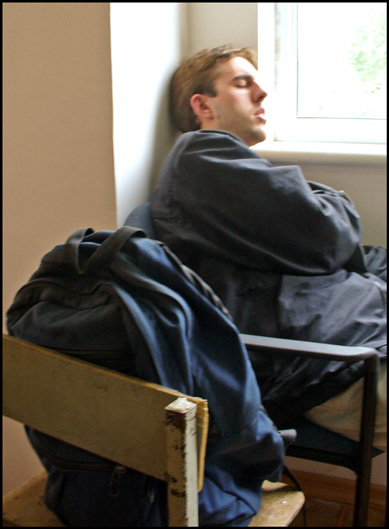
When teaching AP or IB English, one of the most useful things I did each year was to write at least one of the essays I assigned my students. I would select a textual response prompt I had never seen before and, within the same time constraints set on the students, I would read, analyze, and respond. I would then slip my anonymous response in with the model essays we used during review. It was always humorous and enlightening to hear my students praise and criticize my work, and once I revealed my response, they were always appreciative that I had put myself “out there.”

As teachers we can easily fall into the trap of forgetting the messy, recursive and challenging process of learning. As we repeat lessons throughout the day or re-read books each year, we remove ourselves further from the inevitable struggles inherent in any learning process. To heighten my empathy for my students’ challenges and to model good learning in action, I often do my students’ work. I try, at least once a term, to complete one of my own assignments.

I gave an Ignite speech right along with my students. An Ignite speech is five minutes long, and the speaker creates 20 slides that auto-advance every 15 seconds. I have never given such a speech, so I knew I needed to do it as well. I’m glad I did. Had I simply assigned it, I never would have understood how difficult this format really is.

I easily invested six hours into my five minute speech, and I even had to take a “mulligan” when delivering the speech to the class. In the end, however, I am happy with the results.
Continue reading

Paper Airplanes for Freedom: Who Cares?

3 Nov

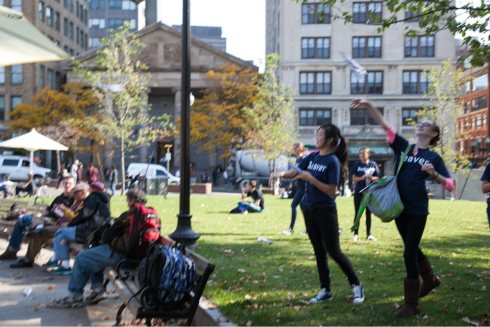
Most teachers would probably naturally intuit this, but carting 20 students to downtown Boston so they may throw paper airplanes at strangers is probably not a good idea. Too many things could go wrong, and why, exactly, would they want to do this in the first place?

I was cautious, but I really care about putting students’ ideas at the forefront of learning, so we executed this harebrain idea anyway. It did not go so well. And, it was a huge success.

How can it be both? First some background….We used CNN’s Freedom Project throughout the term as one source for our research on modern slavery. One posted assignment, Paper Airplanes for Freedom, intrigued us. It is pretty simple: make a paper plane, write messages of solidarity on it, launch it, and encourage those that pick it up to do the same. It’s a novel way of spreading awareness. More slaves exist in the world today than at any point in human history….27 million by some counts. 

As we brainstormed our own ideas for raising awareness, the students had an overwhelming urge to create a public action. During the idea generating and iteration phases, “Paper Airplane Flash Mob” rose to the top. The students and I thought it represented a chance to grab people’s attention and make a lasting impression.  We also thought we could execute it relatively easily.

Continue reading

27 Million Dots (or Why Design Thinking Is Worth the Extra Effort)

27 Oct

As I sat in line waiting to buy some blue paint and Goo-b-gone, the time creeping past 8:00 p.m., I thought, “Does any of this really have anything to do with English class?” This year I began my sophomore English classes with a project on modern slavery, and even though we moved on to topics like Gatsby’s impossible dream and the nuances of parallel structure, the Modern Slavery Project is still going, taking more and more of my time.

This re-occurring unit is one of which I am very proud. I have written about our work in the past, and every year I attempt to reboot this project, I start by showing past work and asking, “Now…what do YOU want to do?”

For the past two years this has meant tweaking the basic pattern from previous years: students research an aspect of modern slavery, create a video PSA, and write letters to various organizations and individuals, all the while making connections to Harriet Jacob’s Incidents in the Life of a Slave Girl. This work is always engaging, interesting, and original, but this year I pushed my students to think about ways to amplify their voices and increase their impact.

I utilized some design thinking training that is part of Beaver’s in-house professional development. I built in more time to INSPIRE (a research stage of the design process), and we took our ideas through a longer process of iteration. My students were particularly keen to take our work beyond the classroom walls, and they devised some novel ideas to do so:

27 Million Dots: Make Your Mark

One section transformed a three story hallway in the building by painting 27 million dots to represent the total number of slaves in the world today. This idea is inspired by Paper Clips, the documentary about children at a Whitwell, TN middle school collecting six million paper clips to represent the six million lives lost in the Holocaust.  The students generated many ideas about how to best create a physical representation of such a large number, but the plan that emerged as most “doable” and having the most impact was the dots.

Continue reading

Low Prep #Reading Quizzes that Are Quick to Grade

20 Oct

As an English teacher I must sometimes act as a gatekeeper. I care deeply about engendering a love of reading in my students, and I work diligently toward that end…but I also create situations where I just try to determine a very basic answer to a very basic question, “Did you read it or not?”

This step seems obvious, but many teachers leave this fundamental question to chance. They believe their students will read because they were told to read, but I argue that this kind of trust is actually a disservice to the learners in our classrooms. I am a very optimistic man who believes in second chances and basic human decency, but as an English teacher I am also a crusty, pragmatic troll guarding a bridge. If you didn’t read the book, you’re not getting by me. Let me explain…

I always give a reading quiz the day before I want to discuss the book. This simple step allows me time to determine who has read, and it gives unprepared students a bit of time to catch up. With these quizzes I check for basic reading completion one of three ways:

Continue reading

Design Thinking: It’s Natural to Be a Bit Confused

11 Oct

Socratic Ignorance can teach us something about our attitudes toward Design Thinking. Socrates earned his rep for being a wise man by admitting, “I don’t know.” When he wanted an answer, he would go to the experts of his day and unleash a series of questions that eventually lead to the politician, economist, philosopher, teacher, butcher, or farmer replying, “I don’t know.” Of course, in the process of all his questioning, Socrates learned much, but he never saw knowledge as static. Instead, he applied a consistent method to an ever-moving target.

I know that, for me, the concept of design thinking can feel like a moving target. Ask ten people for a definition of design thinking, and you’ll receive ten different definitions. And, what is the difference between design thinking, studio learning, Project-based Learning (PBL), Problem-based Learning (PBL), experiential learning and Challenge-based Learning? Honestly, I don’t know.

I’m being cheeky, though. I do know…kind of. There are subtle differences between these various approaches, but I am beginning to think these differences don’t matter much. In fact, I think these various approaches are different “brandings” for a very elemental concept that most educators intuit to be true and effective and elegant:

When we give students real situations they must navigate and use timely feedback and provocative questions to guide students in revising work until it is truly original, personal, and professional…real learning happens.

I have spent considerable time in recent years reading, researching, observing, and questioning just what design thinking means in the context of the classroom. In the process, I have learned much about how I can create student-centered learning experiences that put the onus of critical decision making on the students, not me. In this post I share some of the most useful resources I have found:

Continue reading

Occam’s Razor, Summer Reading Essays, and Google Docs

1 Oct

I am ashamed. Why do simple solutions often elude me? I have been using Google Docs for five or six years now, and one of the main beefs I have with the system is the highlighting tool. It seems like such a small thing, but there is not a way to leave the highlighting tool “on.” I want—desperately—to sweep my cursor across the page, highlighting text as if I had a physical highlighter in hand. Word allows this. Google Docs, however, requires several clicks and menu choices to highlight something, and the process slows things down considerably, especially for an English teacher who reads hundreds of essays in a year and is always on the hunt for ways to shave seconds off the feedback process.

Just last week I realized I have been ignoring a simple solution. I can simply use the comments keyboard shortcut [Option+COMMAND+M] to save considerable time. Now, I highlight my selection, hit a few keys, and then type a quick note: “error #.” It’s so much simpler…and I am a bit sickened by the time I have wasted.

Continue reading

Little Things Add Up and Other Life Lessons

18 Sep

I begin each week in the classroom with a Life Lesson. These lessons typically last five minutes, but my goal is to share with students some truth I hold dear. This week’s lesson: Little Things Add Up.

A few years ago Steve Bergen, while teaching at the Children’s Storefront School in Harlem, NY, started a Billion Penny Project. The idea began as a math lesson and quickly blossomed into a novel fundraising campaign. CBS picked up the story and ran this piece. I was part of the campaign and even made a brief appearance on national TV. Blink and you will miss me; I am in the red sweater:

Continue reading

Building Effective Classroom Discussions #1st5days

12 Sep

I will admit it. I steal many of the great ideas I use in the classroom. If you want to be a better teacher, you probably find inspiration from others, too.

Steal, of course, is a harsh word. I always give credit. But,  while I know I am a creative teacher in my own right, I have no problem using someone else’s great idea.

Early in my teaching career I attended a Building Success workshop sponsored by the College Board, and the facilitator gave this suggestion. (I would give his name if I knew it; I have tried to find it). Early in the school year, he posts the following list somewhere in the classroom:

  •      – The correct answer
  •      – An educated guess
  •      – A wild guess
  •      – A blank stare

He then begins class by asking students to consider the list and answer the following question: “Which response do you learn the most by giving?” I have stolen his idea every year.

Continue reading

Grading Essays How-To: Use Macros to Save Time

3 Sep

Here is the skeleton in every writing teacher’s closet: grading essays is soul sucking, mind-breaking work. After fifteen years of dedicating obscene chunks of personal time to the task, I wish I could reveal some cure-all that makes grading fast and euphoric. I can’t. Of course, I find many moments of joy, but the bone-weary reality of the life of an English teacher is that it takes considerable time and significant effort to create meaningful feedback. No matter how I try, I can’t seem to write comments on an essay in less than fifteen minutes. Realistically, it often takes more time. I have experimented with many methods of feedback, but when I need to leave a healthy dose of ink, I use a hybrid approach of handwritten feedback and computer editing tools known as macros. This method doesn’t help me grade more quickly, but it does ensure that I maximize my time. Here’s my basic structure for working through a stack of essays: 

  • Students turn in two copies of an essay, one printed and one electronic copy via Google Docs.
  • I write more quickly on a piece of paper than I can highlight on a computer screen (I have timed each activity), so I go “old school” and leave marks on the page. The two to five minutes I save on each essay quickly add up. I also use a set of symbols to speed this marking process along.
  • I type longer comments that I later print and attach to the essay. I use macros (more on this step below) for common comments, but I also individualize feedback. I always limit myself to one page of typed comments per essay.
  • When finished, I photocopy the completed scoring rubric (which I will use during the revision process), print the one page of typed comments, and then staple the typed comments, the marked essay, and the scoring guide into one packet.
  • I give students at least one week to revise based on my feedback. I require a revision of every major essay, and I use the electronic copy in Google Docs to track the changes. The revision history in Google Docs feature shows me when and where changes were made. Because I made a photocopy of the scoring guide before handing back the essays, I simply look through the revision history on the computer and make changes to the photocopied scoring guide (another time-saver). I do NOT write any additional comments, as the students will not revise this draft, and I am not a glutton for punishment (even though this post may make you think that!)

Continue reading

Classroom Management Based on Respect and Consensus #1st5days

24 Aug

Recently my uncle came out of retirement to become a classroom teacher. He worked as a vocational instructor for many years in the prison system, but he was, understandably, pretty nervous about teaching a roomful of teenagers. They can have that affect on the best of us. He will be fine, of course. When I asked him why he decided to take the job, he said, “I really care about the kids who struggle to learn. I was one of those kids, and I told my classes on the first day, ‘I’ll never embarrass any of you. If you don’t understand something, I’ll work with you whenever and wherever you want…and if I don’t know how to help, I’ll find somebody that can help me help you.” He’s going to be great, isn’t he?

He will take care of his students and they will take care of him. Teenagers’ reputation is unfounded. In my time in the classroom I’ve always found them to be some of the loveliest people I know. Teens have abundant optimism, honesty, and a sense of fair play, and we can tap into these wonderful qualities when establishing a set of classroom rules.

Here are some of the structures I use to establish a safe, fair, and productive classroom. They are a conglomeration of methods I learned from mentors and students.

Continue reading

MAKE THEM MASTER IT

CONNECTING TEACHERS TO INTENSIFY OUR IMPACT

carlabramowitz

Explore with Curiosity. Create with Love

TeacherToolkit

Most Influential UK Education Blog

Robin Neal

a teacher energized by innovation and collaboration

Popsicles for Dinner

The adventures of Liza and Felix

couponbomb

A year long quest of doing stuff...

Lehrer Werkstatt

Reflections on Living and Teaching in Germany

Student Observation

every day observations from a student's perspective

Empathic Teacher

The Mindful High School Classroom

Expat Educator

Leadership and Educational Practice from Around the World

Ideas Out There

THINK. LEARN. DO. REPEAT...

So, will this be graded?

Stories from a middle school English teacher turned high school English teacher.

History Tech

History, technology, and probably some other stuff

I'm Teaching English

And trying to get better each day. Thanks for your comments!

thefreshmanexperience

Life's lessons learned from students at school...

TED Blog

The TED Blog shares news about TED Talks and TED Conferences.

WordPress.com News

The latest news on WordPress.com and the WordPress community.

Classroom as Microcosm

Siobhan Curious Says: Teachers are People Too